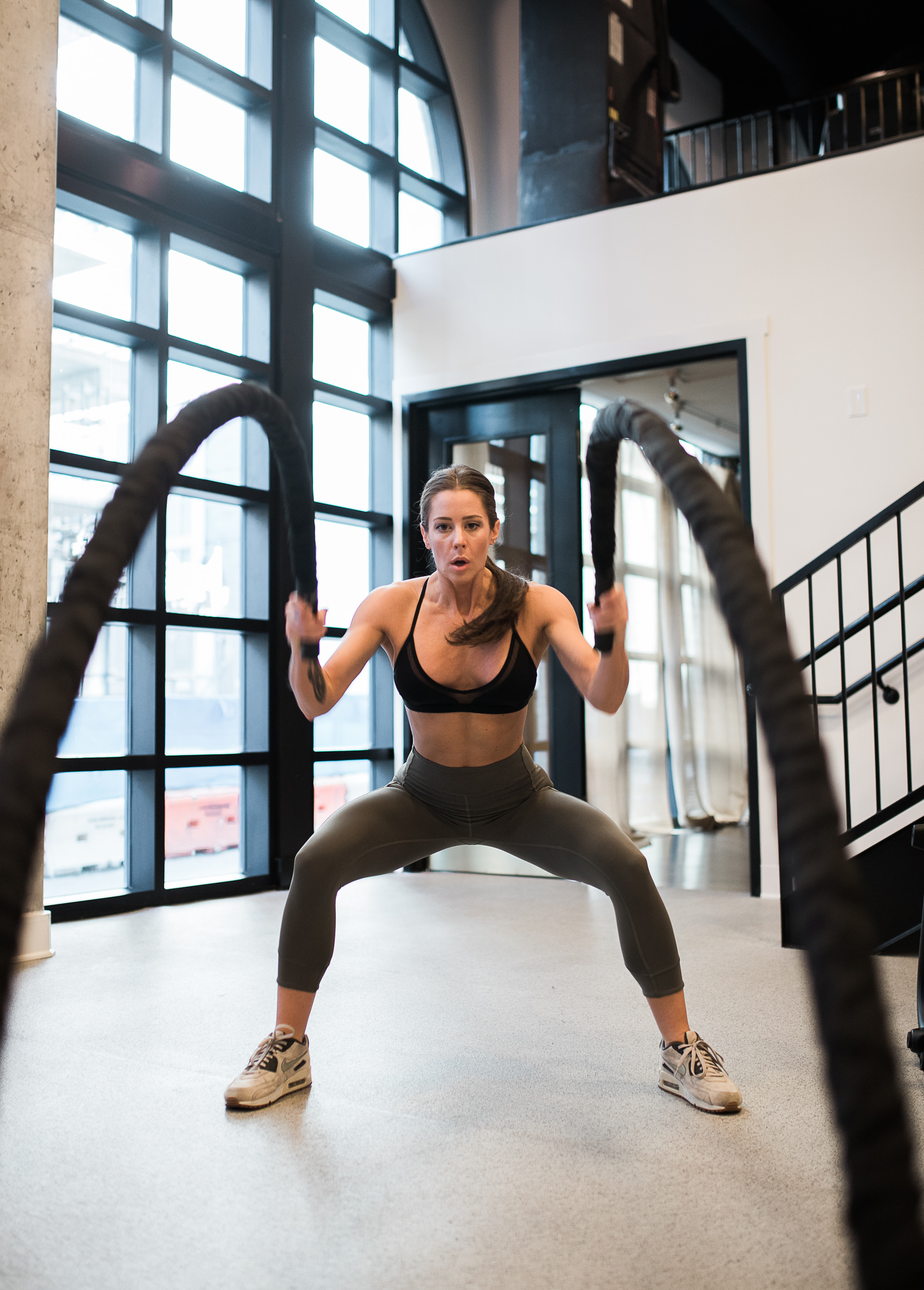
High-intensity interval training has accumulated impressive research support — and an equally impressive body of overclaimed marketing. The eight movements below are genuinely useful for building cardiovascular fitness and improving body composition. The word "rapid" in HIIT headlines deserves immediate correction before you start.
A 2023 meta-analysis by Guo et al. (International Journal of Environmental Research and Public Health) pooled 29 randomised controlled trials comparing HIIT with moderate-intensity continuous training. The finding: the two approaches produced equivalent reductions in BMI and absolute fat mass. HIIT had small statistical edges in waist circumference (0.96 cm) and percentage body fat (0.48%), but neither translated to meaningfully faster fat loss. HIIT's real advantage is time — comparable outcomes in significantly less time. The sustainable target remains 0.5–1 lb (roughly 0.25–0.5 kg) per week within an overall caloric deficit.
What HIIT actually does (and doesn't)
HIIT alternates near-maximal effort with recovery intervals, driving heart rate into the 85–95% maximum range during work periods and producing strong cardiovascular adaptation. The "afterburn" or EPOC (excess post-exercise oxygen consumption) claim is real but modest — it typically adds 6–15% to session energy expenditure, roughly 20–50 kcal for a typical session. That's not the "hours of extra burn" often written about. More importantly, research by Speakman and Pontzer et al. (Current Biology, 2021) found people compensate for about 28% of exercise-driven calorie burn through reduced unconscious movement throughout the rest of the day. Don't use a HIIT session as licence to dramatically increase food intake.
Diet remains the primary lever. Swift et al. (2014) quantified the gap: isolated aerobic exercise without dietary change produces roughly 0.2 kg per week; caloric restriction alone produces about five times as much. HIIT plus a modest calorie deficit is more effective than either alone — the combination is where good results are.
Who HIIT is and isn't for
HIIT is high-impact. Burpees, jump squats, box jumps, and jumping lunges place significant load on knees, ankles, and hips with every rep. If you have current joint pain, a history of lower-limb injury, or have been sedentary for more than a year, 4–6 weeks of steady-state cardio (brisk walking, cycling, slow jogging) is the right starting point — build structural capacity before challenging it hard. Consult a physio or GP if you have existing joint issues, are significantly overweight, or have a heart condition. For the full range of cardio approaches, 18 Best Cardio Exercises for Weight Loss covers low-impact to high-intensity options.
For people with the physical readiness for it, 3 sessions per week is the well-supported dose — with at least 48 hours between sessions. Daily HIIT without adequate recovery produces diminishing adaptation and rising injury risk.
The 8 movements
1. Burpees
The highest heart-rate-spike movement in most HIIT programmes — a squat, plank transition, push-up (optional), and jump combined into a full-body circuit. Form: Drop hands to floor, jump or step feet back to plank, lower chest to floor (full burpee) or hold plank (modified), jump feet forward, drive up into a jump with arms overhead. Land softly through the whole foot with knees tracking over toes. Modified version: Step back instead of jump, no floor touch — appropriate for those building toward the full movement. Dose: 30–40 sec work, 20–30 sec rest; 8–12 reps per interval when fresh.
2. Jump squats
Lower-body strength with explosive power and high cardiovascular demand. Form: Feet shoulder-width apart, squat to roughly 90 degrees with chest tall and knees tracking over toes. Drive explosively through heels to jump, extending fully at the top. Land softly through toes then heel, absorbing through bent knees — never land stiff-legged. Anyone with knee pain should replace with a regular squat or box squat. Dose: 35–40 sec work, 20 sec rest; 12–18 reps per interval.
3. Mountain climbers
Running-in-place in a plank position — one of the few HIIT movements that simultaneously loads the core in anti-extension while driving high cardiovascular demand. Form: High plank, hands under shoulders, body in a straight line. Drive alternating knees toward chest rapidly, switching legs continuously. Keep hips level throughout — don't let them rise or drop. Control pace before form breaks down. Wrist-sensitive athletes can use push-up handles or parallettes. Dose: 40 sec work, 20 sec rest; 24–40 single-leg contacts per interval.
4. Jumping lunges
Explosive unilateral lower-body work with high cardiovascular response — requires mid-air coordination. Form: Start in a lunge, front knee at roughly 90 degrees. Drive explosively off both feet, switch legs in the air, land in the opposite lunge position. Absorb through both feet simultaneously and control the back knee's descent. Keep torso upright. Anyone with knee or hip pain should replace with a reverse lunge or split squat. Dose: 30–35 sec work, 25 sec rest; 10–16 switches per interval.
5. High knees
Running on the spot with exaggerated knee drive — accessible, low-equipment, and easy to scale. Form: Drive alternating knees up to at least hip height, landing on the ball of the foot each step. Pump arms in opposition. Keep torso upright and core engaged so hip flexors don't do all the work. A gentler-landing option than jump squats or jumping lunges — a good starting point for building HIIT capacity. Dose: 40 sec work, 20 sec rest; 50–80 single-foot contacts per interval.
6. Plank jacks
Core stability under dynamic load with a cardiovascular element — lower-impact than most other HIIT movements while still elevating heart rate meaningfully. Form: High plank, hands under shoulders. Jump both feet out to slightly wider than hip-width, then immediately back together. Keep hips level throughout — don't let them rise with the foot spread. Maintain a tight core; no lower-back sag. Suitable as a lower-impact substitute in circuits where the primary movements are higher-impact. Dose: 40 sec work, 20 sec rest; 20–30 jacks per interval.
7. Kettlebell swings
One of very few HIIT movements that loads the posterior chain — glutes, hamstrings, lower back — under ballistic demand. The technique is specific: done as a hip hinge, it's highly effective; done with a bent-knee squat pattern, it's a back injury. Form: Feet slightly wider than hip-width, hinge at the hips (shins relatively vertical), grip the kettlebell and pull it back between legs. Drive hips forward explosively to swing the bell to chest or shoulder height — power comes from the glutes, not the arms. Let it swing back between legs and immediately repeat. Arms guide the bell; hips drive it. Anyone with lower back history: get physio clearance first. Dose: 30–40 sec work, 20–25 sec rest; 15–20 swings per interval.
8. Box jumps
Explosive lower-body power with significant cardiovascular demand. The landing on the box (absorb into a quarter squat) is safer than some alternatives; always step down rather than jump down — particularly in fatigued states. Form: Stand 30–45 cm in front of a sturdy box (45–60 cm height). Load into a quarter squat, swing arms back, drive up explosively, land softly on the box in a quarter squat absorbing through hips and knees. Stand tall, then step down one foot at a time. New to jump training: begin with step-ups to build confidence before adding the plyometric component. Dose: 30 sec work, 30 sec rest; 8–12 jumps per interval.
A 20-minute HIIT routine
Warm-up (3 min): Brisk walking or light jogging in place, leg swings front-to-back and side-to-side, arm circles, bodyweight squats, hip circles. Dynamic movement only — no static stretching before HIIT.
Choose 4 movements from the list above. Perform 40 sec work, 20 sec rest per movement; cycle all 4 = 1 round (4 min); complete 4 rounds (16 min total); cool-down (1 min slow walking, then static stretches). Rest 60 sec between rounds when starting out; reduce rest as fitness improves. Form throughout matters more than pace — slow down technique before slowing down pace.
Beginner: High knees + plank jacks + bodyweight squats + mountain climbers (all lower-impact, no jumps). Intermediate: Jump squats + mountain climbers + burpees + high knees. Advanced: Burpees + jumping lunges + kettlebell swings + box jumps.
Realistic expectations and the diet piece
Three HIIT sessions a week, done consistently, will improve cardiovascular fitness noticeably within 4–6 weeks and shift body composition meaningfully within 8–12 weeks — when combined with a calorie-appropriate diet. The research (Swift et al., 2014) is clear: exercise without dietary adjustment produces modest fat loss; diet is the primary lever. HIIT sessions burning 200–350 kcal contribute meaningfully to the deficit but don't replace the dietary piece. HIIT is demonstrably effective at maintaining weight loss once achieved — Jensen et al. (eClinicalMedicine, 2024) found exercise maintainers regained only 3.6 kg on average versus 9.6 kg in other groups. Exercise is where the long-term maintenance advantage sits. On the dietary side, evidence-based approaches to sustaining a calorie deficit cover the nutrition half of the equation in detail. Pairing HIIT with structured weight training for fat loss builds the lean-mass base that makes long-term body-composition change stick.
A note on safety
HIIT is demanding. If you experience chest pain, dizziness, unusual shortness of breath beyond what effort normally produces, or any sharp joint pain, stop immediately. Chest pain or pressure, pain radiating to the arm or jaw, or fainting are signs to seek emergency medical attention. If you have a known cardiac condition, are over 45 with multiple cardiovascular risk factors, or have not exercised in several years, speak with your GP before starting a HIIT programme. Build in at least 48 hours between sessions and combine HIIT with resistance training and lower-intensity active days for a complete programme.
Frequently asked questions
Does HIIT burn more fat than regular steady-state cardio?
Is the afterburn effect from HIIT real?
How many HIIT sessions per week are recommended for fat loss?
Is HIIT safe for beginners who want to lose weight?
Sources
- Effect of High-Intensity Interval Training vs. Moderate-Intensity Continuous Training on Fat Loss and Cardiorespiratory Fitness in the Young and Middle-Aged: A Systematic Review and Meta-Analysis — International Journal of Environmental Research and Public Health (2023)
- Aerobic Exercise and Weight Loss in Adults: A Systematic Review and Dose-Response Meta-Analysis — JAMA Network Open (2024)
- The Role of Exercise and Physical Activity in Weight Loss and Maintenance — Progress in Cardiovascular Diseases (2014)



Comments (0)