"Supercharge your day" is the kind of phrase that should make any reader slightly suspicious — most morning routines just set up the day slightly better than not doing them. What the routine below will actually do is more modest and more useful: ten minutes of deliberate movement and breath that wakes up the body, brings attention into the present, and creates a small buffer between sleep and the demands of the day. Over weeks and months, that is a meaningful intervention. Ten minutes is short enough that you will do it on days when 30 wouldn't happen, and long enough to work through the spine, hips, and breath in ways a token two-minute stretch wouldn't touch.
The poses are sequenced progressively — gentle mobilisation, then standing work, then a brief grounding close. No equipment beyond a mat or clear patch of floor. One safety note: the body is at its stiffest first thing, and the sequence ramps gradually rather than dropping you straight into deep work. If you have a current back injury, herniated disc, sacroiliac dysfunction, or any sharp or radiating pain, speak with a physiotherapist before starting. Sharp pain in any pose means back off immediately; mild stretch sensation is fine.
On the weight-loss angle: a 2018 review in the Journal of Exercise Nutrition & Biochemistry found that non-exercise daily movement (NEAT) can vary by up to 2,000 kcal per day between similar-sized adults. But yoga at gentle-to-moderate intensity does not reach the aerobic threshold needed to drive significant fat loss on its own — that requires at least 150 minutes per week of moderate-to-vigorous activity, per the 2024 ACSM Expert Consensus. The honest claim for a 10-minute morning practice: consistent daily movement, improved stress regulation, better sleep quality, and the habit-anchoring effect of starting the day intentionally — outcomes that translate into better adherence to everything else.
1. Constructive rest pose (2 minutes)
Do not skip this. Most morning routines launch straight into movement, missing the most useful 90 seconds — the deliberate transition from sleep to awareness.
How to do it: Lie on your back, knees bent, feet flat on the floor hip-width apart. Arms at your sides, palms up. Close your eyes. For two minutes, notice the natural breath — no need to deepen it, just observe it.
Mindfulness cue: The point is not to clear the mind. Notice you are in your body and set the tone for attention on physical sensation rather than the day ahead.
Modify if: Uncomfortable supine — folded towel under the head, or do this seated in a chair.
2. Knee-to-chest releases (1 minute)
Decompresses the lower back and releases overnight spinal stiffness — one of the most reliably useful movements for easing into wakefulness.
How to do it: From your back, draw the right knee toward the chest, holding the back of the thigh or shin. Hold 20 seconds. Switch to the left knee for 20 seconds. Then both knees to the chest for the final 20 seconds.
Mindfulness cue: Breathe slowly through the nose. Notice where the stretch shows up — different bodies feel it in different places.
Modify if: Hip issues — use a strap around the back of the thigh, or press the foot gently into the floor with the knee less deeply bent.
3. Cat-cow (1 minute)
The single best mobility movement for waking up the spine — flexion and extension through the full range without loading, in one minute.
How to do it: Hands and knees, wrists under shoulders, knees under hips. Inhale, drop the belly toward the floor, lift the chest and tailbone (Cow). Exhale, round the spine upward, tuck the tailbone, drop the head (Cat). 6 to 8 full cycles with the breath.
Mindfulness cue: Let the breath set the pace. If the movement is fast and the breath is short, slow both down.
Modify if: Wrist pain — drop to forearms or fists. Severe disc pain on extension — reduce the Cow component.
4. Downward-facing dog (1 minute)
Stretches the entire posterior chain, opens the shoulders, and gently inverts the body — useful for circulation and the mild clarity that brief inversions produce.
How to do it: From hands and knees, tuck the toes and lift the hips up and back. Bend the knees as much as needed. Spread the fingers, press through the knuckles. Hold 30 seconds, then pedal the heels gently for the final 30 seconds.
Mindfulness cue: Notice the effort in the arms and shoulders, not just the leg stretch. Drop the head and let the neck release.
Modify if: Wrist pain — forearm version. High blood pressure — do not hold the head below the heart for extended periods. Recent shoulder injury — substitute a standing forward fold.
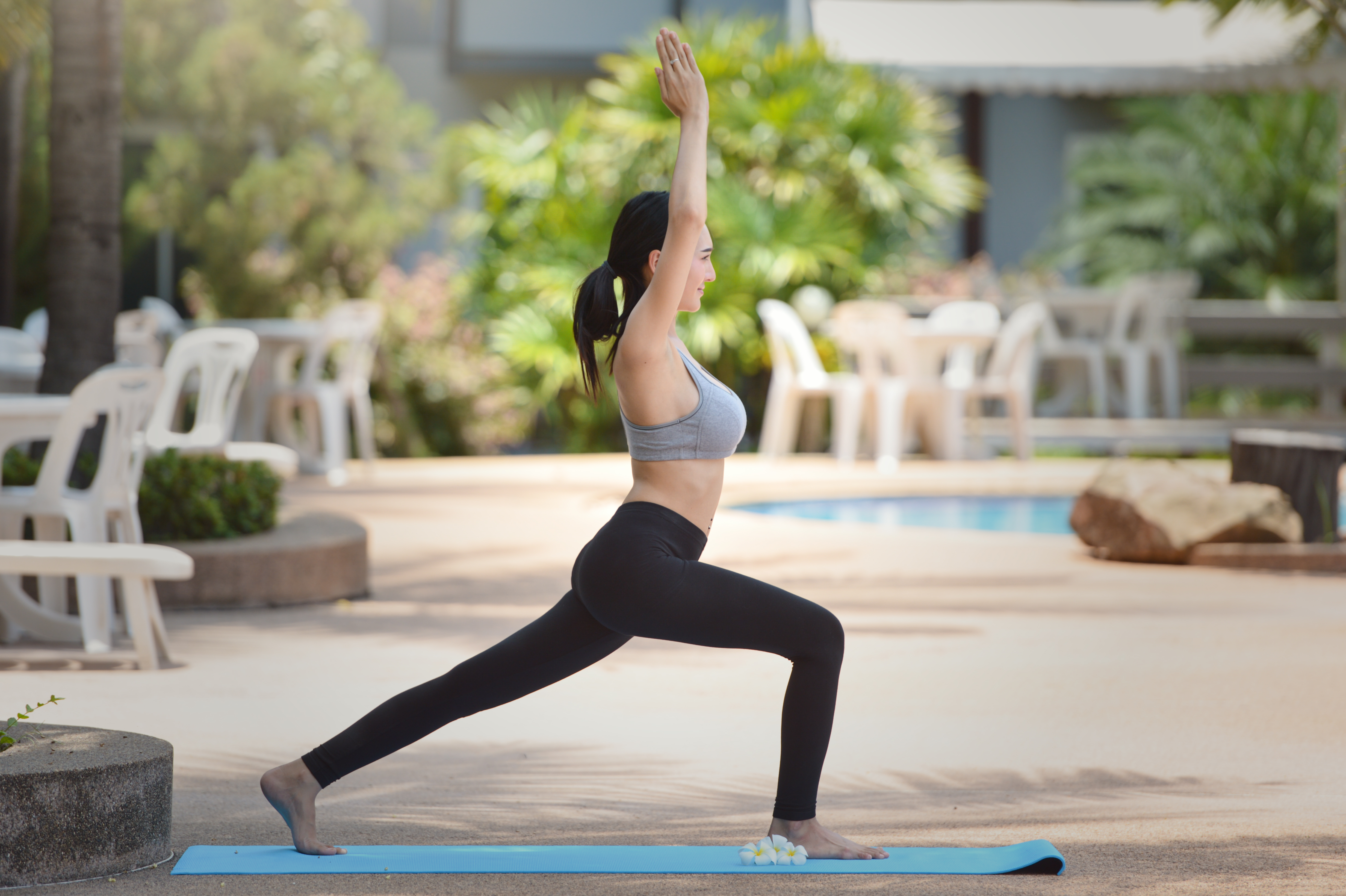
5. Low lunge with reach (1 minute)
The hip flexors are most affected by sleep position and prolonged sitting. Low lunge gives them a focused stretch and counteracts the forward-folded position the body spends most sedentary time in.
How to do it: From downward dog, step the right foot forward between the hands. Lower the left knee to the floor. Right knee directly over the right ankle. Reach both arms up overhead. Hold 30 seconds, breathing into the front of the left hip. Switch sides.
Mindfulness cue: The stretch is in the front of the rear hip. If you're not feeling it there, sink the hips slightly more forward.
Modify if: Knee pain — use extra padding under the rear knee. Hip impingement — reduce the depth of the lunge.
6. Standing forward fold — bent knees (1 minute)
A gentle spinal decompression and posterior-chain stretch. Bent knees are the safer default in the morning; forcing straight legs before tissues warm up reliably strains the lower back.
How to do it: Step the rear foot forward. Stand feet hip-width apart, knees bent generously. Fold forward from the hips, letting the torso hang. Hands rest on shins, blocks, or the floor. Head and neck relax. Hold 30 to 60 seconds.
Mindfulness cue: Let the weight of the upper body do the work. Notice the lower back release on each exhale.
Modify if: Disc issues with leg pain — skip entirely. High blood pressure, glaucoma, or late pregnancy — use a supported version or skip.
7. Mountain pose with arms overhead (1 minute)
Standing done deliberately engages posture from the feet up and gives the body a moment of vertical strength after all the folding and reaching.
How to do it: Stand tall, feet hip-width apart, weight even. Lengthen the spine. Inhale and reach the arms slowly overhead, palms facing each other. Exhale and bring them down. Repeat 5 to 6 times, taking the full breath for each movement.
Mindfulness cue: Notice how the body feels different from when you started — the spine is longer, hips are more open, breath is deeper.
Modify if: Shoulder injury — reach only to a comfortable height. Vertigo — do not tilt the head back.
8. Seated forward fold with strap (1 minute)
Deeper stretch to the hamstrings and lower back in a stable position that can be held longer without balance demands.
How to do it: Sit on the floor, legs extended. Sit on a folded blanket if the lower back rounds excessively. Loop a strap or towel around the soles of the feet. Inhale to lengthen the spine; exhale and fold forward from the hips using the strap — not by rounding the back. Hold 60 seconds.
Mindfulness cue: The fold happens at the hips. If the back is rounding heavily, bend the knees. The goal is length in the spine and legs, not touching the toes.
Modify if: Disc issues, sciatica, or hamstring strain — bend the knees significantly or sit against a wall with the strap.
9. Legs up the wall (1 minute)
The restorative close — lets the nervous system settle and circulation reset after eight minutes of active work. One minute is short but useful; the pose rewards a longer hold if you have time.
How to do it: Sit with one hip against a wall. Swing the legs up the wall as you lie back. Legs extended vertically, back flat on the floor. Arms relax to the sides, palms up. Stay 60 seconds or longer.
Mindfulness cue: Notice the difference in your body compared to the constructive rest pose at the start.
Modify if: Glaucoma, severe hypertension, or late pregnancy.
10. Sit and set an intention (1 minute)
The final minute is the most often-skipped and, for many people, the most valuable. After the physical work, sit briefly and set a deliberate intention — not a to-do list, but one word that names the quality of attention you want to bring to the day.
How to do it: Sit comfortably with a tall spine. Close your eyes. Take three slow breaths. Ask yourself: how do I want to be today? Pick one word — "patient," "focused," "calm," "present." Hold it for the rest of the minute. Open your eyes.
Mindfulness cue: The bridge between the practice and the day. The word does not need to be impressive; it needs to be honest.
Where this leaves you
The honest expectation: this routine done daily for several weeks produces real changes in morning stiffness, baseline stress, postural awareness, and the quality of attention you bring to the rest of the day. A 2019 doubly labelled water study in Obesity (Ostendorf, Catenacci, et al.) found that successful long-term weight-loss maintainers averaged roughly 12,000 steps per day and expended about 175–191 kcal/day more in physical activity than controls — not through intense workouts, but through consistently high daily movement. A morning routine that anchors the day's first intentional movement builds the same kind of durable habit.
For the broader case for a daily yoga practice, our piece on five simple daily yoga exercises covers which poses provide the best return on a short practice. For combining yoga with broader morning movement, our first-person account of starting morning exercise covers the habit-formation side. For tips on sustaining a home practice, nine tips for practising yoga at home effectively addresses the practical obstacles most home practitioners face.


Comments (0)