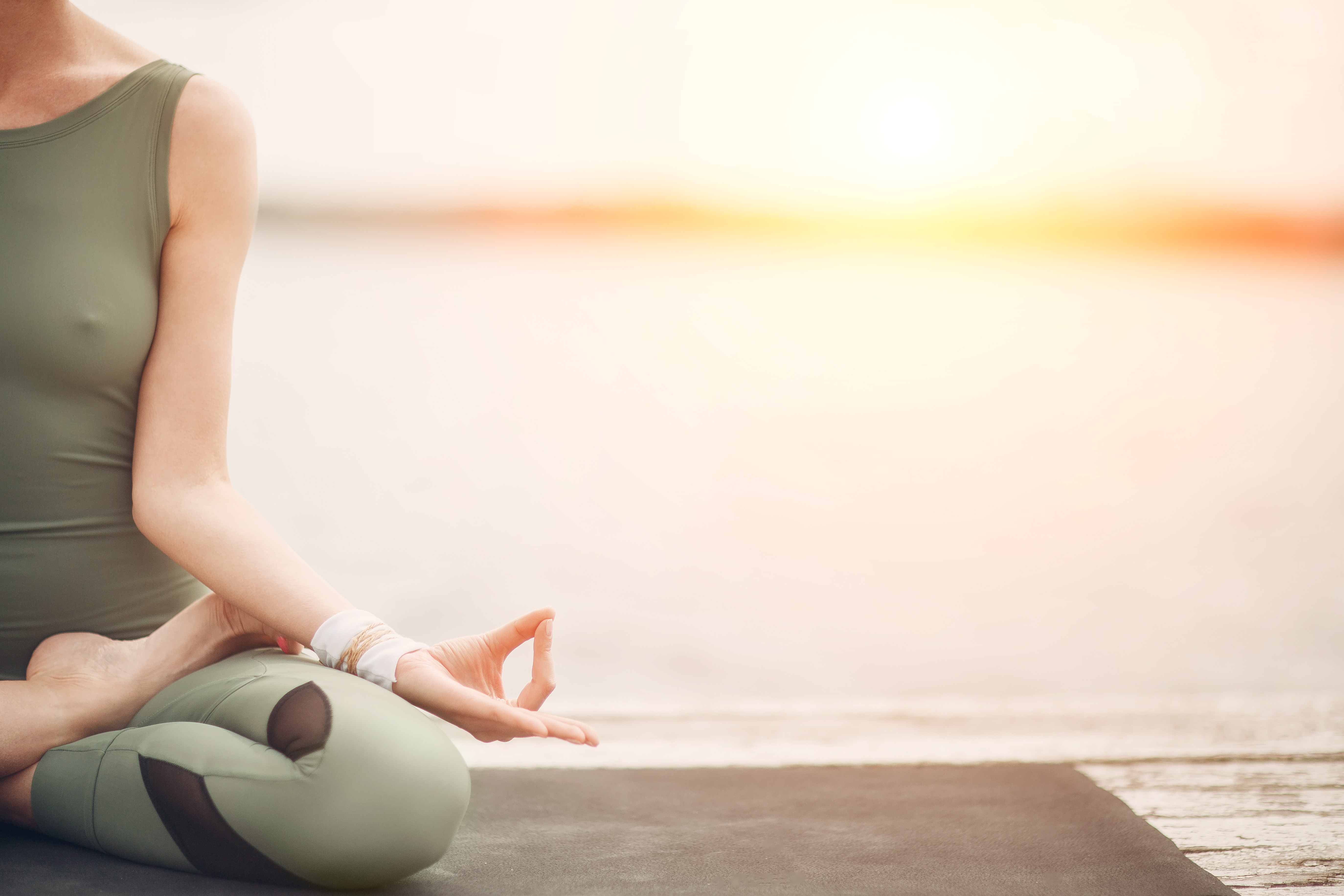
A studio membership helps — scheduled classes, instructor corrections, social pressure. But none of those are strictly necessary. The research on yoga's benefits doesn't require a studio: reduced perceived stress, better sleep, improved flexibility, lower injury risk compared with higher-intensity training (ACSM, 2024). The single biggest advantage yoga has over more demanding exercise is adherence — people actually keep doing it. That matters more than any short-term calorie count.
1. Dedicate a specific space
The space doesn't need to be large — a mat-length of clear floor (roughly 1.8 m × 0.7 m) covers nearly every foundational sequence. What matters is that it's designated. Contextual cueing is a well-established habit-formation mechanism: your brain learns to associate a location with a behaviour, reducing the friction of starting. When the space signals "yoga happens here," you spend less willpower talking yourself into beginning. If space is tight, a corner you consistently use — with the ritual of unrolling the mat as the cue itself — serves the same function. Ensure enough head clearance for a standing arm stretch, a non-slippery surface, and reasonable light. A tidy, consistent space outperforms an elaborate "yoga room" you never actually use.
2. Keep the mat visible, not in a closet
BJ Fogg's behaviour-design research (Tiny Habits, 2019) identifies friction as a primary reason good intentions fail: if doing the behaviour requires an extra step — opening a cupboard, retrieving equipment — that step becomes a bail-out point. Keeping your mat rolled out or propped against a wall eliminates the decision. The mat on the floor is a passive prompt. You walk past it, step on it for three minutes, and three minutes often becomes twenty. A mat stored neatly under the bed is invisible — and invisible habits don't get formed. If aesthetics matter, a slim wall hook keeps it visible without looking like gym equipment was left out.
3. Pick a time and honour it
Implementation intentions — specific "when/where/then" commitments — dramatically improve follow-through compared with vague plans. Each time slot has genuine trade-offs. Morning practice gets it done before the day's interruptions accumulate. Joint stiffness is higher in the morning, so move more slowly into poses for the first five minutes. Morning practice also correlates with lower cortisol through the day. Evening practice activates the parasympathetic nervous system, counteracting the day's sympathetic arousal; slower sequences with longer holds improve sleep in ways that compound across weeks.
Pick the slot you can actually protect. A consistent 15 minutes three mornings a week beats an aspirational 60-minute daily plan abandoned by Thursday. One missed day doesn't break a habit — the research on habit formation is clear on this. Two consecutive misses are the warning sign. After a gap, return without guilt and without making the next session punishingly long to "compensate."
4. Use a teacher, not a Pinterest pose list
A curated pose list produces scattered, disconnected sessions. Sequences have a logic — warming specific muscles, progressing to deeper work, cooling down — invisible when jumping between screenshots. Structured sequences produce better adherence and lower injury rates; a teacher anticipates alignment mistakes and removes the decision fatigue of figuring out what comes next.
- Yoga with Adriene (YouTube, free): Accessible, extensive library across all levels. Her "30 Days of Yoga" series is an effective structured entry point — sequences build on each other at a realistic 20–30 minute runtime.
- Breathe and Flow (YouTube, free): Higher production quality, more athletic sequences. Better once you're past beginner fundamentals.
- Down Dog (app, freemium): Algorithmically generates sequences based on your chosen duration, level, and focus area. Useful if variety is important to you.
- Glo (app, paid): Strong library of structured courses with multiple teachers and a formal progression.
If you experience sharp, localised pain (not the expected stretch sensation) during any pose, stop that movement. For a structured starting rotation, 5 Simple Daily Yoga Exercises for Good Health provides a straightforward sequence you can fold into home practice.
5. Start with 15–20 minute sessions
A 60-minute session feels more "serious" but is far more likely to be skipped — it requires a full uninterrupted hour at the right energy level with no competing demands. That combination rarely aligns. Fifteen to twenty minutes is long enough for complete work: brief warm-up, four to six poses with proper breath, and a closing rest. That is a real practice, not a sample. The ACSM (2024) classifies yoga as light to moderate intensity activity — its primary benefits at home-practice volumes are flexibility, stress reduction, body awareness, and the adherence advantage that makes it sustainable. Once the 15–20 minute habit is stable, extending to 30 or 45 minutes feels natural rather than an imposition. Build duration only when the shorter session has become automatic.
6. Rotate 3–4 sequences
Novelty is appealing but routine is what builds capacity. If every session is a different random sequence, you never develop fluency with specific poses or notice week-over-week improvement. Identify three or four sequences and rotate through them:
- A morning energising sequence (sun salutations + standing poses)
- A hip and hamstring focus (seated forward folds, pigeon, low lunge variations)
- A shoulder and upper back sequence (useful for desk workers)
- A restorative or yin sequence for evenings or rest days
Returning to the same sequences lets you notice concrete progress — a hamstring releasing further than two weeks ago, a balance pose held four breaths instead of two. That feedback loop is motivating in a way that constant variety is not. For core engagement within your rotation, Top 10 Yoga Poses for Core Strength is a useful structured addition.
7. Invest in one good mat
Equipment minimalism is a genuine virtue in home fitness. For yoga, one piece of equipment matters: the mat. Everything else (blocks, straps, bolsters) is optional and substitutable with household items. A thin, slippery mat makes standing balance poses genuinely dangerous, makes floor poses uncomfortable, and makes the practice feel worse than it is.
- Thickness: 4–5 mm is the practical sweet spot — thinner is lighter but harder on knees and wrists on hard floors; thicker (6+ mm) cushions more but reduces stability in standing poses.
- Grip: Natural rubber grips better than PVC in sweaty conditions; PVC is more durable for dry practice. The mat should not slide on your floor — test this before committing to a spot.
- Length: Standard mats are 173 cm. If you're taller than 175 cm, a 183 or 200 cm mat is worth the modest price difference.
Avoid the cheapest foam mats — they compress quickly, lose grip, and shed material. Mid-range mats from reputable brands perform adequately for years of daily home practice.
8. Breathe audibly — learn ujjayi breath
Most beginners breathe shallowly or hold their breath during effort, which defeats a significant part of what yoga does physiologically. Ujjayi breath — a slight constriction at the back of the throat producing a soft ocean-wave sound — activates the parasympathetic nervous system, counteracting cortisol and sympathetic arousal. This is why yoga tends to reduce perceived stress rather than simply fatigue the body: the breath is doing real regulatory work.
- Breathe in through your nose. As you exhale, constrict the back of your throat slightly — as if fogging a mirror, but with your mouth closed. You'll hear a soft hiss.
- Inhale and exhale should be roughly equal — try four counts in, four counts out as a starting point.
- The breath should be audible to you but not to someone across the room.
When you lose the breath — when it becomes shallow or disappears — that's the signal you've moved into a pose you're not ready for. Use breath quality as real-time feedback: back off or hold where you are. A practice where you breathe continuously is more effective than a tighter pose held in breath-holding. If mornings are your time, the 10-Minute Mindful Morning Yoga Routine builds breath awareness into a practical short sequence.
9. End with savasana — don't skip it
Savasana (lying flat on your back, arms slightly away from the body, eyes closed) is consistently the pose beginners most want to skip — it feels like "just lying down." This misunderstands what it's doing. The physical work of a yoga session creates muscular micro-stress and nervous system arousal; savasana is the integration period — parasympathetic recovery, heart rate settling, muscles processing the work. Skipping it leaves the nervous system partially elevated and the practice's stress-reduction benefit partially unclaimed. Even three to five minutes is meaningful. Set a timer so you're not watching the clock. If your lower back is uncomfortable flat on the floor, place a rolled blanket or bolster under your knees. The combination of consistent breath work through a session and a complete savasana is the primary mechanism through which regular yoga reduces cortisol and improves perceived stress over weeks — not the dramatic part of the practice, but possibly the most consequential.
One more honest note on weight loss and yoga
Yoga is marketed aggressively as a weight-loss tool, and this deserves honest framing. At typical home-practice volumes — 20 to 45 minutes, three to five times per week — yoga is light to moderate intensity activity (ACSM, 2024). Its direct caloric expenditure is modest compared with running, swimming, or strength training at equivalent durations. What yoga does offer: it builds body awareness that tends to improve food choices over time; it reduces cortisol, with downstream effects on appetite regulation and abdominal fat storage; and — most importantly — it gets done. The adherence advantage is real. A practice you keep for two years produces different outcomes than a more intense programme you quit after six weeks. If weight management is a goal, yoga is best understood as a supportive, sustainable component of a broader active life — not a primary intervention on its own. For a short sequence oriented toward weight management as part of that broader routine, The 10-Minute Gentle Yoga Routine is a practical starting point.
Frequently asked questions
Can you do yoga effectively at home without attending a studio?
Does yoga help with weight loss?
How long does it take to form a yoga habit at home?
What time of day is best for doing yoga at home?
Sources
- How are habits formed: Modelling habit formation in the real world — European Journal of Social Psychology (2010)
- Physical Activity Energy Expenditure and Total Daily Energy Expenditure in Successful Weight Loss Maintainers — Obesity (2019)


Comments (0)